
Contents
ToggleBlog 35-ZED Certification Govt Scheme for MSMEs: From Quality Improvement to Global Opportunities
The MSME Sustainable (ZED – Zero Defect, Zero Effect) Certification Scheme helps MSMEs/ businesses to reduce defects, waste and environmental impact while adopting better processes and globally competitive practices.
This blog explains the key objectives, ZED principles, assessment parameters, certification levels, eligibility, application process, government subsidies and financial benefits. It also explores how ZED can support MSMEs in improving operational efficiency, strengthening market credibility, becoming more export-ready and accessing larger business opportunities.
The latest 2026 data highlights the growing adoption of ZED, including its reach among women-led MSMEs and the increasing support available for certified enterprises.
Introduction
The ZED (Zero Defect, Zero Effect) Certification Scheme encourages MSMEs to adopt better manufacturing practices, reduce defects, minimize environmental impact and improve their overall competitiveness.
Customers, large corporations, government buyers and international markets are no longer evaluating businesses only on price. Quality, reliability and sustainability are becoming increasingly important factors. Businesses are also expected to maintain consistent quality, reliable processes and environmental responsibility.
MSMEs are therefore expected to deliver products and services that meet high quality standards while complying with increasing environmental and sustainability requirements.
To help MSMEs meet these expectations, the Ministry of MSME launched the MSME Sustainable (ZED – Zero Defect Zero Effect) Certification Scheme.
The scheme provides financial subsidies, banking concessions and support for operational improvements to help small and medium businesses adopt zero-defect and zero-effect practices.
The concept was introduced with the vision of making Indian manufacturing more globally competitive through two key principles:
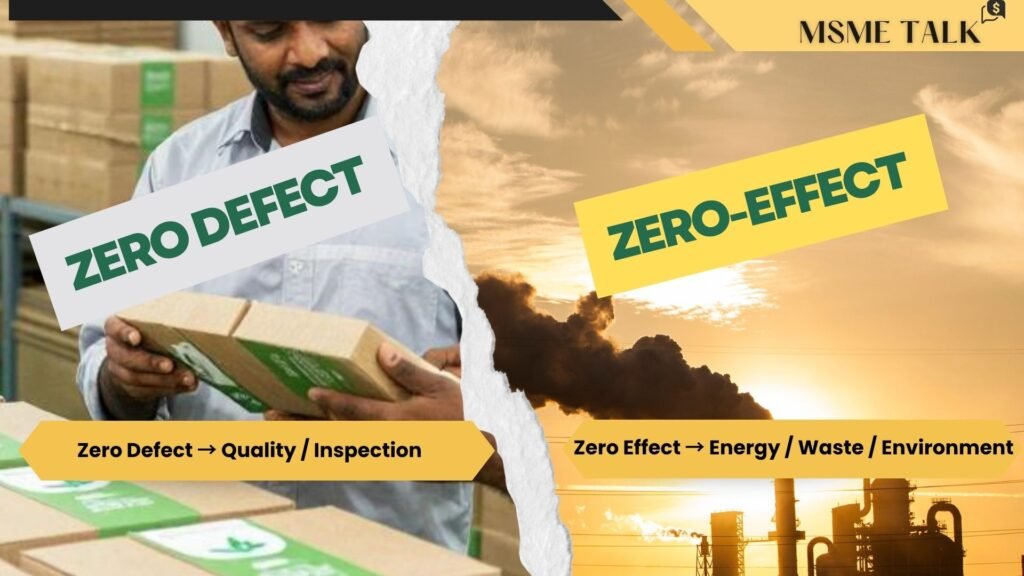
- Zero Defect – Manufacturing products with minimal defects and maintaining consistent quality.
- Zero Effect – Ensuring that manufacturing processes have minimal adverse impact on the environment.
Rather than being viewed merely as a certification, ZED serves as a framework that guides MSMEs towards continuous improvement. It helps enterprises move from basic operational practices towards better quality, efficiency, sustainability and globally competitive manufacturing and service standards.
Growing Reach and Impact of the ZED Scheme
According to the Ministry of MSME, as of 7 July 2026:
- Around 9.49 lakh MSMEs have registered under the ZED Scheme.
- More than 6.67 lakh Bronze Certifications have been awarded.
- Over 6,700 Silver Certifications have been awarded.
- More than 4,800 Gold Certifications have been awarded.
- The Government has provided over Rs. 913 crore in financial assistance to support quality and sustainable manufacturing initiatives.
The scheme’s impact has extended beyond certification:
- 22 States and Union Territories have incorporated ZED into their industrial policies and offer additional incentives to certified MSMEs.
- 19 financial institutions provide benefits to ZED-certified enterprises, including concessions in processing fees and interest rates.
MSMEs can receive:
- Up to 75% support for testing, product, system and certification costs, subject to a maximum of Rs. 50,000.
- Up to Rs. 2 lakh for consultancy and handholding support.
- Up to Rs. 3 lakh for adopting cleaner technologies, pollution-control measures and Zero Effect solutions.
These incentives make ZED not only a quality certification programme but also a practical business improvement and sustainability tool.
Why Was the ZED Scheme Introduced?
Many MSMEs face common operational challenges such as:
- High rejection rates and quality issues
- Production inefficiencies
- Excessive material wastage
- Rising energy and utility costs
- Lack of standardized processes
- Difficulty in meeting export quality requirements
- Limited acceptance among large corporate buyers
These challenges can increase operating costs and reduce competitiveness.
The ZED Scheme was introduced to help MSMEs systematically address these issues by adopting better quality and sustainability practices.
The broader objective is to create a stronger MSME sector that can compete with international manufacturers while contributing to sustainable industrial growth.
The scheme aims to help Indian MSMEs become more competitive by focusing on both quality and sustainability.
1. Promote Quality Excellence
The scheme encourages enterprises to manufacture products with minimal defects through better process controls, quality management systems, standard operating procedures and continuous monitoring.
2. Encourage Sustainable Manufacturing
The scheme promotes environmentally responsible practices such as:
- Energy conservation
- Water management
- Waste reduction
- Pollution control
- Resource efficiency
3. Improve Productivity and Efficiency
By identifying inefficiencies and operational bottlenecks, MSMEs can improve productivity while reducing unnecessary costs.
4. Enhance Competitiveness
A ZED-certified MSME demonstrates its commitment to quality and sustainability. This can help the enterprise differentiate itself in domestic and international markets.
5. Facilitate Export Growth
Global buyers increasingly prefer suppliers that can demonstrate quality and environmental responsibility. ZED can help MSMEs improve their export readiness and prepare for such buyer expectations.
6. Encourage Continuous Improvement
The scheme encourages enterprises to continuously upgrade their processes rather than treating certification as a one-time activity.
(Adopting Circular Economy ideas can help businesses to grow exponentially, want to know how? Listen to MSME TALK latest Episode #31 Circular Economy and MSMEs Ft. Siddharth Lulla, Principal- Intellecap)
Core Principles of ZED
The ZED framework is based on two core principles: Zero Defect and Zero Effect.
Zero Defect
The Zero Defect component focuses on producing high-quality goods with minimal errors or rejections.
This involves:
- Better quality control systems
- Standardized manufacturing processes
- Skilled workforce training
- Defect prevention rather than defect correction
- Continuous monitoring and improvement
The potential benefits include:
- Lower rejection rates
- Reduced customer complaints
- Better product reliability
- Higher customer satisfaction
Zero Effect
The Zero Effect component focuses on reducing the environmental impact of business operations and manufacturing processes.
This includes:
- Efficient use of raw materials
- Reduced emissions and pollution
- Lower energy consumption
- Waste minimization
- Water conservation
The potential benefits include:
- Lower operating costs
- Better compliance with environmental requirements
- Improved corporate image
- Greater acceptance among global buyers
(If you are an Industry Expert, then Share about your expertise with us on MSMETALK Podcast)
Key Parameters Assessed
The ZED assessment evaluates MSMEs across multiple operational areas, including:
Quality Management
- Product quality control
- Process standardization
- Defect management
- Customer satisfaction systems
Productivity
- Production efficiency
- Resource utilization
- Process optimization
- Inventory management
Energy Management
- Energy conservation measures
- Efficient equipment utilization
- Monitoring of energy consumption
Environmental Management
- Waste reduction
- Recycling practices
- Pollution control measures
- Water conservation
Workplace Management
- Safety practices
- Employee welfare
- Skill development
- Compliance systems
Business Excellence
- Leadership commitment
- Documentation systems
- Risk management
- Continuous improvement initiatives
(Subscribe for alerts to stay updated with launch of new podcast episodes and blogs about MSMEs & Startups)
How MSMEs Can Leverage ZED
The MSME Sustainable (ZED) Certification Scheme helps MSMEs improve their quality, productivity and environmental performance. MSMEs can leverage the scheme in the following ways:
1. Reduce the Cost of Certification and Improvement
The ZED Scheme provides financial support to eligible MSMEs for certification and certain improvement activities.
- Certification subsidy: The government provides a subsidy on certification costs based on the size of the enterprise—80% for Micro, 60% for Small and 50% for Medium enterprises.
- Additional support for women-owned MSMEs: Women-owned MSMEs can receive 100% subsidy on certification costs, subject to the applicable scheme provisions.
- Support for improvement: Financial assistance is also available for activities such as consultancy and handholding, cleaner technology adoption and product testing, within the prescribed limits of the scheme.
This can make it easier for smaller enterprises to undertake structured quality and sustainability improvements without bearing the entire cost themselves.
2. Explore Better Financing Opportunities
ZED certification can also strengthen an MSME’s business profile when approaching financial institutions.
- CGTMSE benefits: ZED-certified MSEs may be eligible for a 10% concession in the annual guarantee fee under CGTMSE, subject to the applicable guidelines.
- Banking incentives: Some financial institutions offer concessions such as lower interest rates or reduced processing fees to eligible ZED-certified enterprises.
MSMEs should check the current terms offered by their lender rather than assuming that certification automatically guarantees a lower-cost loan.
3. Strengthen Participation in Government Procurement
ZED certification can be relevant for MSMEs looking to supply to government departments, PSUs and other institutional buyers.
Depending on the applicable procurement rules and individual tender conditions, ZED-certified enterprises may receive certain preferences, incentives or concessions.
For MSMEs, this can add credibility to their quality and process-management practices when participating in institutional procurement.
4. Improve Market and Export Readiness
ZED can help MSMEs build more systematic approaches to quality, process control, resource efficiency and environmental practices.
For enterprises looking to enter larger domestic supply chains or export markets, these improvements can help them become better prepared to meet buyer expectations.
However, ZED certification should not be treated as a substitute for country-specific certifications, technical standards or regulatory requirements. Exporters may still need to meet the standards and compliance requirements applicable to their target market and product.
5. Improve Operational Efficiency
One of the practical benefits of the ZED approach is that it encourages MSMEs to examine their production processes and identify areas for improvement.
This can help enterprises work towards:
- reducing defects and rework
- minimising material wastage
- improving productivity
- reducing energy and resource consumption
- strengthening quality-control processes
- improving workplace practices
- adopting cleaner technologies
- reducing avoidable production costs
Rather than viewing ZED only as a certification, MSMEs can use the assessment process to identify specific operational gaps and improvement opportunities.
6. Use ZED as Part of a Long-Term Business Improvement Strategy
For MSMEs, the value of ZED goes beyond obtaining a certificate. The framework can be used as a structured approach to continuously improve quality, productivity and environmental performance.
An enterprise can use its ZED journey to:
- identify process gaps
- prioritise improvements
- track operational performance
- strengthen documentation and quality systems
- prepare for larger customers and supply chains
- improve resource efficiency
- build a stronger quality and sustainability profile
The key is to treat ZED as an ongoing improvement process rather than a one-time certification exercise.
Benefits of ZED Certification
1. Improved Market Credibility
ZED certification serves as an independent validation of an enterprise’s commitment to quality and sustainability.
It can help improve:
- Customer confidence
- Supplier credibility
- Investor perception
- Brand reputation
2. Better Business Opportunities
Many large corporates and government buyers prefer suppliers with robust quality systems.
ZED-certified enterprises may benefit from:
- Improved vendor registration opportunities
- Enhanced participation in procurement processes
- Stronger relationships with large buyers
3. Operational Cost Reduction
By reducing waste, defects, rework and energy consumption, MSMEs can achieve operational cost savings.
Examples include:
- Lower material wastage
- Reduced machine downtime
- Improved inventory management
- Lower utility expenses
4. Export Competitiveness
International markets increasingly demand suppliers that comply with quality and environmental standards.
ZED certification can help MSMEs:
- Meet International buyer expectations
- Improve export readiness
- Prepare for access to new international markets
ZED Certification Levels
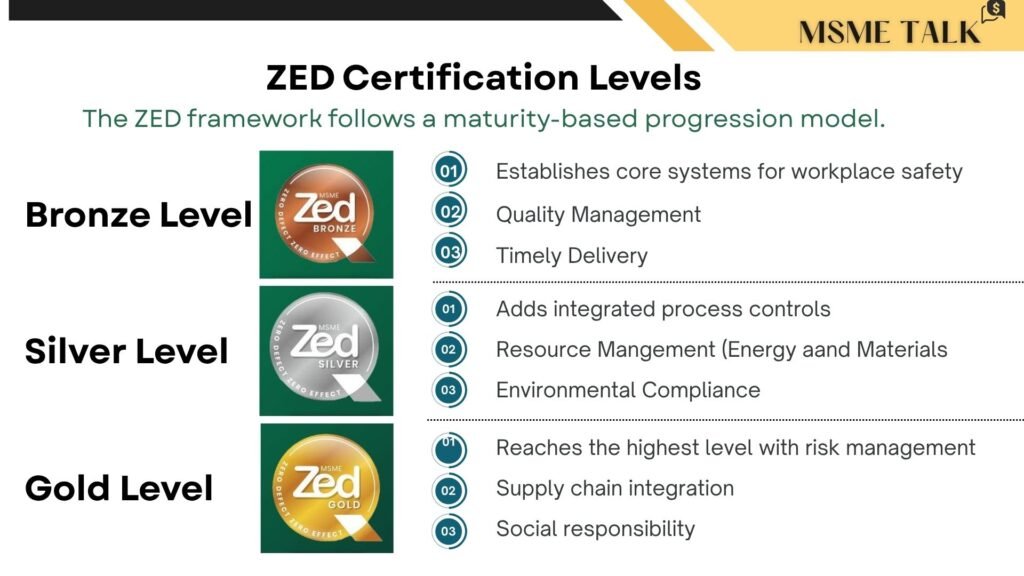
The ZED framework follows a maturity-based progression model.
Level | Description |
Bronze | Basic implementation of quality and environmental practices |
Silver | Improved systems, stronger controls and enhanced compliance |
Gold | Advanced quality and sustainability practices |
The certification framework encourages enterprises to continuously improve their practices and progress from one level to the next.
Eligibility Criteria
To participate in the scheme:
- The enterprise must be registered under Udyam Registration.
- Manufacturing and service sector MSMEs are eligible.
- Enterprises must undergo assessment through authorized agencies.
- The enterprise should be willing to implement improvement measures and comply with applicable ZED requirements.
Certification Cost and Government Subsidy
Application Process for ZED Certification
The ZED certification process is designed as a step-by-step journey. It helps an MSME assess its existing practices, identify gaps, implement improvements and eventually obtain certification.
Step 1: Registration
The MSME first registers for the ZED Scheme through the official ZED portal.
The enterprise needs to provide the required business and Udyam Registration details to participate in the scheme.
Step 2: Self-Assessment
After registration, the MSME conducts a self-assessment based on the ZED framework.
It evaluates its existing practices across areas such as:
- Quality management
- Productivity
- Energy management
- Environmental management
- Workplace management
- Business excellence
This helps the enterprise understand its current level of preparedness and identify areas that need attention.
Step 3: Gap Identification and Improvement
Based on the self-assessment, the MSME identifies gaps between its existing practices and the requirements of the ZED framework.
For example, the enterprise may identify the need to:
- Improve quality-control processes
- Reduce production defects and rejection
- Improve energy efficiency
- Reduce material and water wastage
- Strengthen workplace safety
- Improve documentation and process standardization
The MSME can then take corrective and improvement measures before the external assessment.
Step 4: External Assessment
The MSME undergoes an independent assessment by an authorized or accredited assessment agency.
The assessment examines the enterprise’s practices and performance against the applicable ZED parameters.
This provides an external evaluation rather than relying only on the MSME’s own assessment.
Step 5: Certification
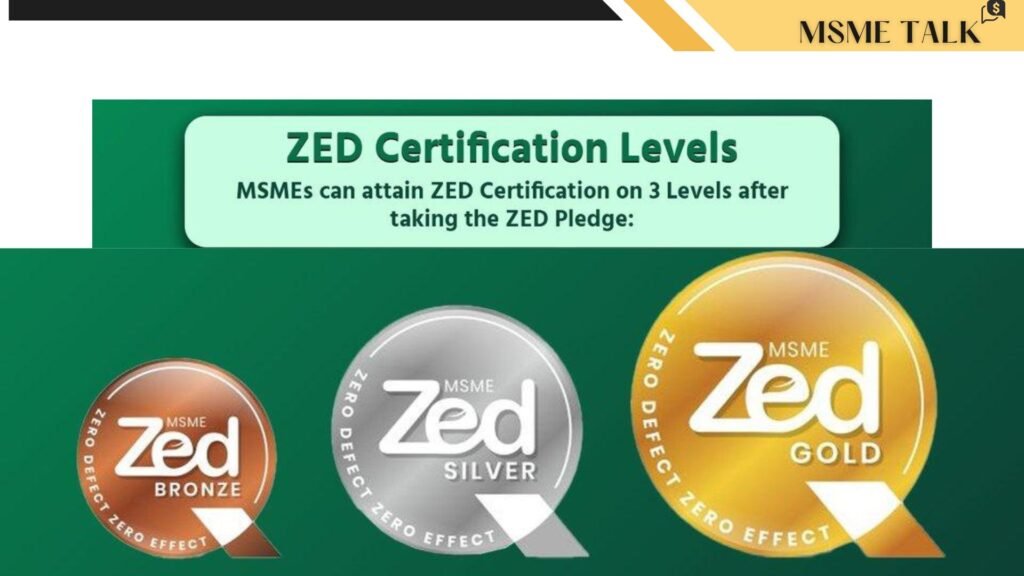
Based on the assessment and the level of compliance achieved, the MSME receives the applicable ZED Certification level – Bronze, Silver or Gold.
The three levels represent increasing maturity in areas such as quality, process control, sustainability and business practices.
Step 6: Continuous Improvement
ZED is not intended to be treated as a one-time certification exercise.
After certification, the MSME should continue improving its processes, reducing defects and waste, improving resource efficiency and strengthening its overall business practices.
Over time, the enterprise can work towards upgrading its ZED certification level and adopting more advanced quality and sustainability practices.
Is ZED Certification Accepted by Other Countries?
ZED is a Government of India MSME certification framework designed to improve the quality, productivity and environmental performance of Indian MSMEs.
It should not be described as a certification that is automatically recognized as an equivalent of an international certification in every country.
An overseas buyer may consider ZED certification as an additional indicator of an MSME’s quality and sustainability practices. However, whether it is accepted or sufficient for a particular export order will depend on the buyer, product and regulations of the destination country.
For example, an exporter may still need to meet specific international standards, product certifications, testing requirements, labelling rules or other regulatory requirements applicable to the destination market.
Therefore, the best way to position ZED for exporters is:
ZED can strengthen an MSME’s credibility and export readiness, but it does not replace mandatory international or destination-market certifications.
The Ministry links ZED with improving competitiveness and enabling exports. ZED-certified MSMEs may also be eligible for certain additional assistance or incentives under relevant government programmes and initiatives.
ZED Certification: Examples and Case Studies
ZED is relevant across a wide range of manufacturing industries because its focus is on quality, productivity, resource efficiency, environmental management and continuous improvement.
MSMEs in sectors such as the following can benefit from adopting ZED practices:
- Automobile and Auto Components – Quality control, defect reduction, process standardization and efficient use of materials.
- Engineering and General Manufacturing – Precision manufacturing, productivity improvement and process control.
- Textiles and Garments – Reduction of fabric wastage, energy and water efficiency, quality consistency and sustainable production.
- Food Processing – Process hygiene, quality management, resource efficiency and reduction of wastage.
- Pharmaceuticals – Process controls, quality management, documentation and environmental practices.
- Leather and Leather Products – Resource efficiency, waste management and environmental compliance.
- Electrical and Electronics Manufacturing – Process standardization, quality control and energy efficiency.
- Metal and Fabrication Industries – Reduction of material wastage, energy management, workplace safety and process improvement.
- Hand Tools and Machinery – Precision, productivity, quality consistency and reduction of rejection rates.
The Ministry’s MSME ecosystem also identifies sectors such as pharmaceuticals, textiles, engineering and food processing as important areas of opportunity for Indian MSMEs. ZED is particularly relevant to manufacturing-intensive sectors where quality, resource consumption and environmental impact directly affect competitiveness.
ZED should therefore not be viewed as a certification meant only for one particular industry. Its principles can be applied across different manufacturing sectors, depending on the nature and scale of the enterprise.
(Are you a business or expert serving MSMEs and startups? Spotlight your services and expertise – partner with MSME TALK to create podcasts, blogs, listings, and social media content that truly reach and inspire!)
Case Study 1 : Auto Component MSME in Pune
Consider a small auto-component manufacturer supplying parts to automobile companies that is facing several operational challenges.
Before ZED
The enterprise faced:
- 5% production rejection rate
- High scrap generation
- Frequent customer complaints
- Rising electricity costs
- Inconsistent quality standards
Improvements Introduced
The company:
- Installed quality checkpoints at every stage of production.
- Trained employees on quality procedures.
- Introduced preventive maintenance schedules.
- Replaced old motors with energy-efficient equipment.
- Implemented waste segregation and recycling systems.
- Began tracking key quality metrics monthly.
Results
After implementing these measures:
- Rejection rates reduced by over 75%.
- Material wastage declined significantly.
- Energy costs fell by approximately 15%.
- Customer complaints reduced substantially.
- The company became a preferred supplier for a major OEM.
This example demonstrates how the principles of Zero Defect and Zero Effect can work together to improve quality, efficiency and sustainability.
(Do not miss blog by Mantraa Advisory- Beyond the Balance Sheet: How Intangibles Shape True Business Value, where it is explained that why intangibles like brand trust, promoter credibility matter more than balance sheets in driving valuations — with real examples from Bisleri, Colgate, Zandu, and Videocon)
Case Study 2: Textile MSME in Surat
Consider a textile manufacturing MSME facing issues related to fabric wastage, production defects and high energy consumption.
After adopting ZED practices:
- Lean manufacturing techniques were introduced.
- Energy-efficient dyeing equipment was installed.
- Water usage was monitored and optimized.
- Process controls were strengthened.
Outcomes
The enterprise achieved:
- Defect rates reduced by around 30%.
- Energy costs decreased by approximately 25%.
- Improved fabric utilization.
- Increase in export orders.
- Significant improvement in profit margins.
This example highlights how improvements in quality, resource efficiency and sustainability can contribute to business growth and international market readiness.
The Government provides financial support to reduce the cost of ZED Certification for MSMEs.
Certification Level | Certification Cost |
Bronze | Rs. 8,000 |
Silver | Rs. 32,000 |
Gold | Rs. 72,000 |
The subsidy on certification cost is provided as follows:
- Micro enterprises: 80% subsidy
- Small enterprises: 60% subsidy
- Medium enterprises: 50% subsidy
- Women-owned MSMEs: 100% subsidy
A Rs. 10,000 joining reward is also available, which can effectively make the Bronze certification free when the reward is availed.
Additional subsidy of 10% is available for SC/ST-owned MSMEs and MSMEs located in the North Eastern Region, Himalayan/LWE/Island territories and Aspirational Districts.
A further 5% is available to MSMEs that are part of SFURTI or the MSE-CDP of the Ministry.
Why ZED Matters for MSMEs
The future competitiveness of MSMEs will depend not only on production capacity but also on quality, efficiency and sustainability.
Today’s buyers increasingly expect:
- Consistent quality
- On-time delivery
- Environmental responsibility
- Regulatory compliance
- Reliable supply chains
The ZED Scheme provides MSMEs with a structured roadmap to work towards these expectations.
By adopting ZED practices, enterprises can work towards reducing costs, improving profitability, strengthening market credibility, accessing larger business opportunities and positioning themselves as globally competitive organizations.
Conclusion
The MSME Sustainable (ZED) Certification Scheme is more than a quality certification programme. It provides a structured framework for MSMEs to improve quality, productivity, sustainability and competitiveness.
By adopting the principles of Zero Defect and Zero Effect, MSMEs can work towards reducing defects and waste, improving operational efficiency, strengthening their market credibility, preparing for new markets and contributing to India’s vision of sustainable industrial growth.
Latest Update: ZED Scheme Gaining Strong Momentum in 2026
The MSME Sustainable (ZED) Certification Scheme continues to expand its reach across India and has emerged as one of the Government’s key initiatives for promoting quality manufacturing and sustainability among MSMEs.
A major development under the scheme is the Government’s focused support for women-led MSMEs.
To encourage greater participation of women entrepreneurs, the Ministry of MSME provides a 100% subsidy on the cost of ZED Certification for women-owned MSMEs, making certification effectively free for eligible enterprises. This provision has been in effect since 11 November 2023.
Stay Connected with MSME TALK®
- Watch & Learn: YouTube Channel
- Updates: Follow on LinkedIn
- Key highlights: Subscribe to Newsletter
Direct Access & Updates
- Broadcasts: Join our WhatsApp Channel (For latest news and trends)
- Alerts: Join our WhatsApp Group (For immediate updates and notifications)
- Queries: Message us on WhatsApp (For direct support)
Email Us :
- connect@msmetalk.com