
Contents
ToggleRXIL: India’s First TReDS Platform for MSME Invoice Financing
This blog explains how the Trade Receivables Discounting System (TReDS) is improving MSME financing in India, while highlighting the role of Receivables Exchange of India Limited, one of the earliest and most established platforms in the ecosystem.
It covers how the platform works, its key milestones, and how MSMEs can convert invoices into quick working capital through a simple, digital process. Through a practical example and a clear explanation of benefits for both sellers and buyers, it highlights how RXIL helps improve cash flow, reduce payment delays, and build credibility-enabling better access to financing over time.
Background: Introduction of TReDS in India
The Trade Receivables Discounting System (TReDS) was introduced by the Reserve Bank of India (RBI) to address the persistent issue of delayed payments to MSMEs and improve their access to working capital. The framework was conceptualised during the tenure of then RBI Governor Raghuram Rajan, with the objective of creating a transparent, digital marketplace where MSMEs could discount their receivables through multiple financiers.
In 2014, RBI issued guidelines for setting up TReDS platforms, enabling electronic auction-based financing of trade receivables and bringing greater efficiency, transparency, and liquidity into MSME supply chain financing.
About RXIL
India’s first TReDS exchange platform, Receivables Exchange of India Limited (RXIL), a joint venture promoted by Small Industries Development Bank of India (SIDBI) and the National Stock Exchange of India (NSE) was established on December 3, 2016.
RXIL enables MSMEs to access faster funding by facilitating early payments against invoices. It reduces payment delays, improves cash flow, and streamlines the credit process. By connecting buyers, sellers, and financiers on a single digital platform, RXIL simplifies transactions and supports MSME growth
RXIL TReDS journey & Key Milestones
The journey of Receivables Exchange of India Limited (RXIL) began with regulatory approval from the Reserve Bank of India in December 2016, marking the establishment of one of India’s first platforms under the Trade Receivables Discounting System (TReDS) framework. RXIL was created as a joint venture promoted by Small Industries Development Bank of India (SIDBI) and National Stock Exchange of India (NSE), with participation from major banks including State Bank of India, ICICI Bank, and Yes Bank.
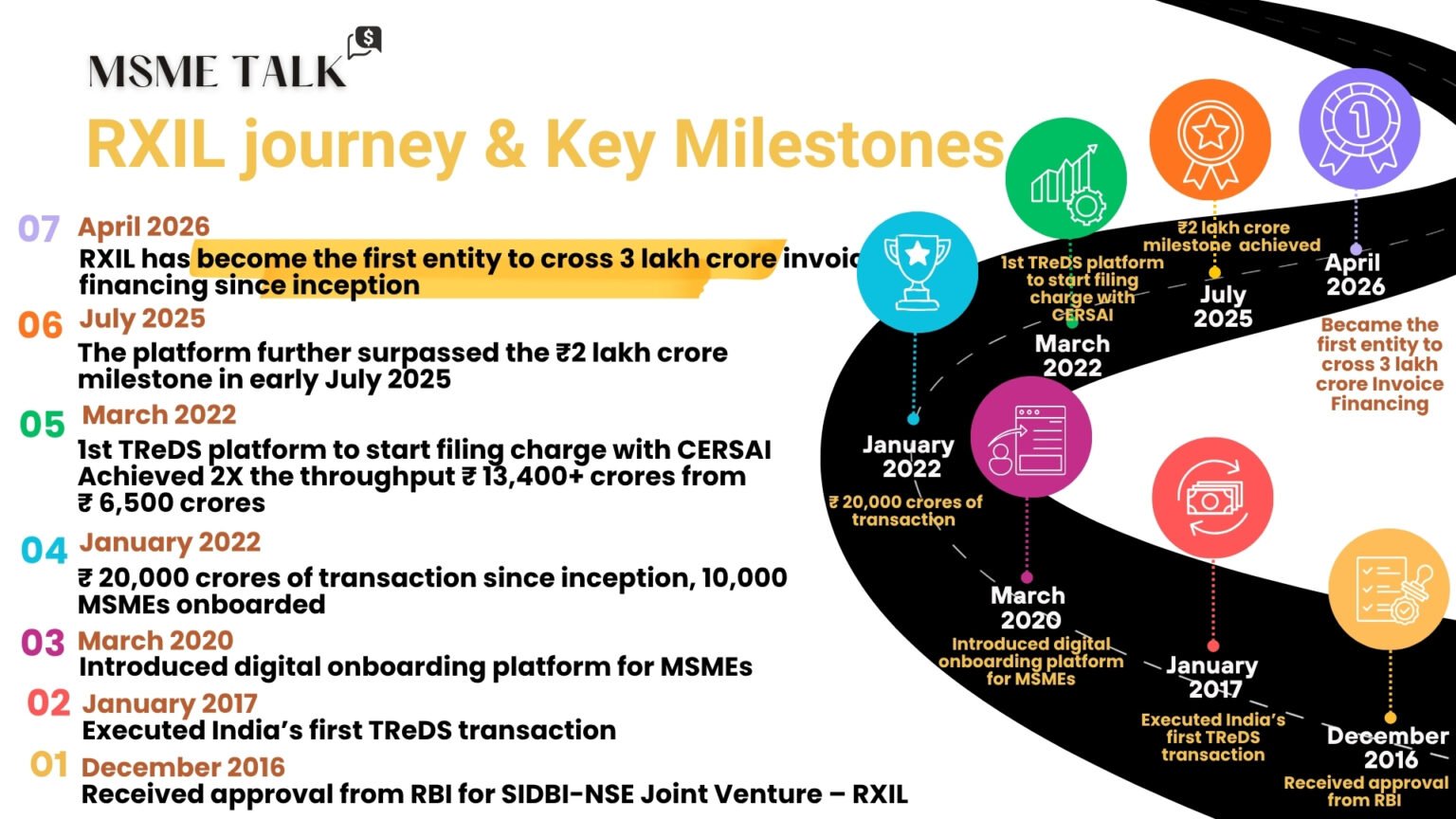
In January 2017, RXIL executed India’s first TReDS transaction, marking the operational launch of the platform and demonstrating the practical implementation of digital invoice financing for MSMEs.
As adoption increased, RXIL introduced fully digital onboarding for MSMEs in March 2020, simplifying the registration process and expanding access to invoice discounting across the country.
By September 2021, the platform crossed ₹1,000 crore in monthly transaction throughput, reflecting growing acceptance of TReDS among corporates, financiers, and MSME suppliers.
In January 2022, RXIL achieved ₹20,000 crore in cumulative transactions since inception and onboarded over 10,000 MSMEs, strengthening its position in India’s supply chain finance ecosystem.
In March 2022, RXIL became the first TReDS platform to integrate with the Central Registry of Securitisation Asset Reconstruction and Security Interest of India (CERSAI) for charge filing, further improving transparency and security in receivable financing transactions. During the same period, the platform crossed ₹6,500 crore in monthly transactions and continued to scale rapidly.
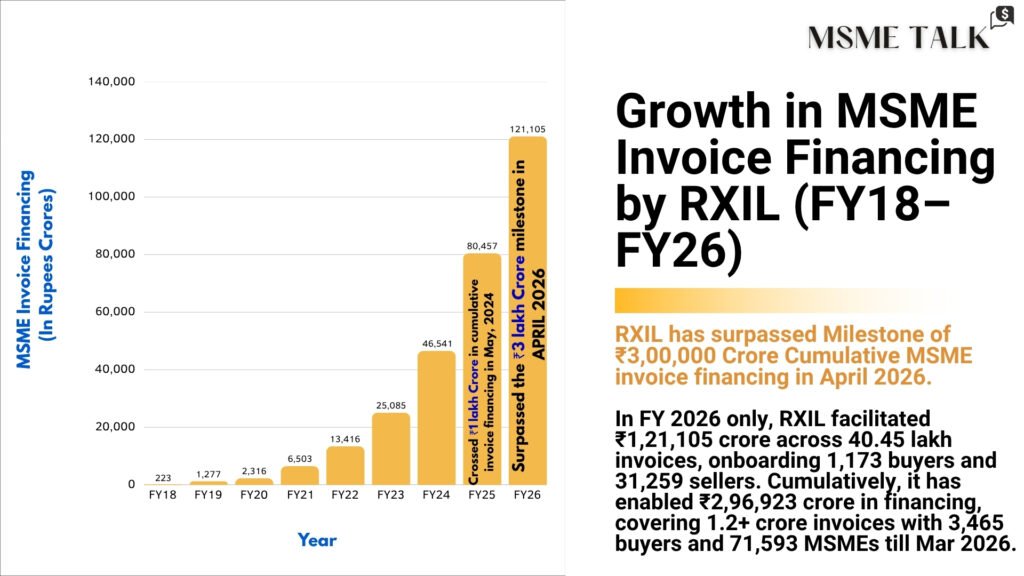
Over the following years, RXIL continued to expand its ecosystem of buyers, financiers, and MSMEs. RXIL crossed the ₹1 lakh crore cumulative invoice financing milestone on May 22, 2024.The platform further surpassed the ₹2 lakh crore milestone in early July 2025 (officially announced on July 4, 2025), reflecting strong ecosystem participation and rapid scale-up of digital invoice financing in India.
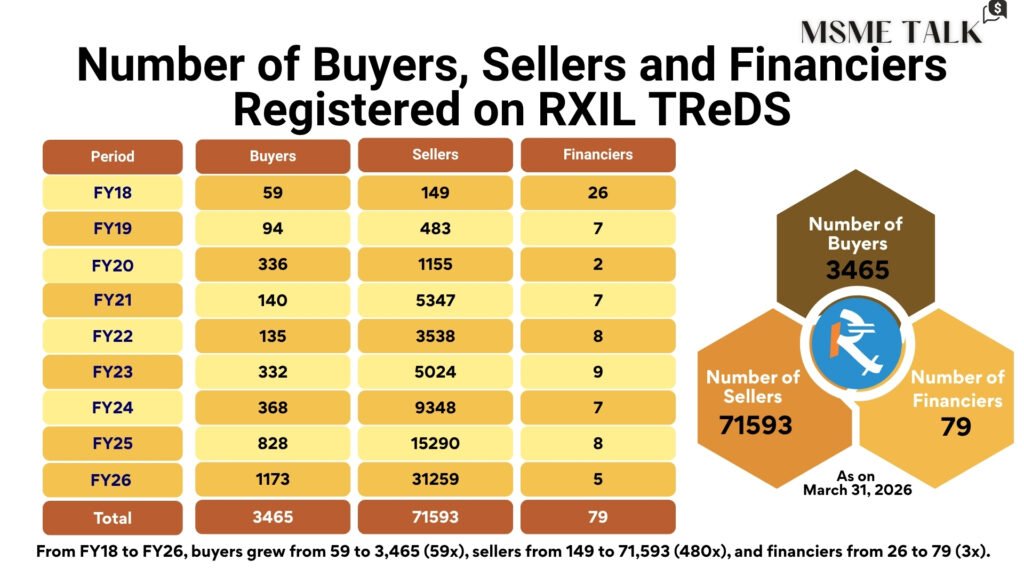
In April 2026, RXIL has become the first entity to facilitate over ₹3 lakh crore in invoice financing, supporting over 71,500+ MSMEs and connecting 3,400+ buyers with 70+ financiers.
In January 2026, RXIL also became the first TReDS platform in India to declare and pay an interim dividend, signalling the maturity and financial sustainability of the platform within the MSME financing Fintech ecosystem.
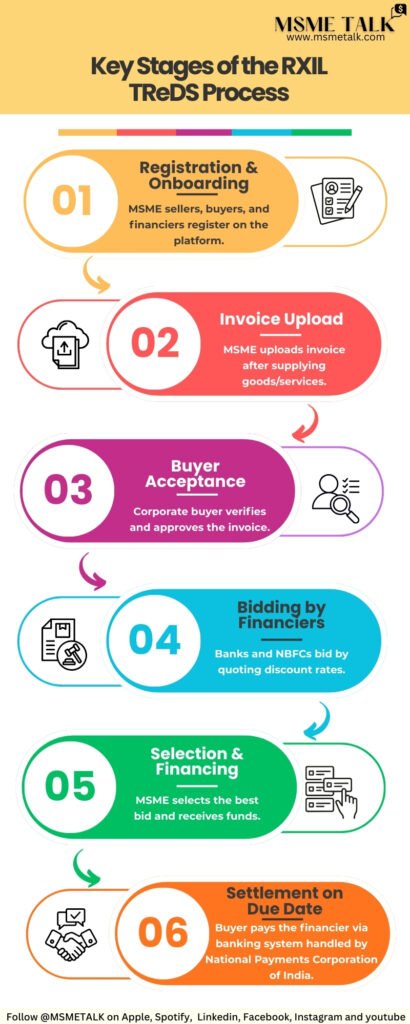
Key Stages of the RXIL TReDS Process
The TReDS mechanism operates through a structured digital workflow that connects MSME sellers, corporate buyers, and financiers on a single platform.
The overall process is transparent, technology-driven, and designed to ensure faster access to working capital while maintaining secure and standardized transactions.
Over the years RXIL has improvised the process in alignment with the ecosystem of Lenders, buyers and MSMEs . Here is the process how an MSME invoice gets converted into cash in 1-2 days on RXIL.
1️ Registration & Onboarding
MSMEs (sellers), corporate buyers, and financiers (banks/NBFCs) first register on the RXIL platform. KYC and basic verification are completed so all participants can transact securely on the system.
2️ Invoice Upload
After supplying goods or services, the MSME seller uploads the invoice on the RXIL platform against the specific corporate buyer.Here, a key requirement is that the buyer must be registered on the RXIL platform for the MSME seller to be able to discount the invoice through RXIL.
3️ Acceptance / Approval
The corporate buyer logs in and verifies the invoice details (amount, due date, goods/services supplied). Once confirmed, the buyer formally accepts the invoice on the platform.
Only invoices accepted by the buyer become eligible for financing on TReDS. This buyer confirmation provides financiers confidence that the receivable is valid and payable.
4️ Bidding by Financiers
Banks and NBFCs registered on the platform view the approved invoice and place competitive bids by quoting discount rates. This auction mechanism helps ensure market-driven pricing.
5️ Selection & Financing
The MSME selects the most suitable bid (generally the lowest discount rate). The chosen financier then disburses funds to the MSME -typically 70–90% of the invoice value upfront-usually within 24–48 hours. The remaining amount (after deducting discount/charges) is adjusted as per the agreed structure.
6️ Settlement on Due Date
On the invoice due date, the corporate buyer pays the full invoice amount directly to the financier. The transaction is then closed on the platform. For this process auto debit is done in the bank account of the buyer by NPCI (National Payments Corporation of India) and payment is done to the financier’s account.
Since the buyer has already accepted the invoice, repayment responsibility shifts to the buyer, reducing payment follow-up and recovery burden for the MSME.
In simple terms:
Seller uploads invoice → Buyer approves → Financiers bid → Seller receives early payment → Buyer pays financier on due date.
Benefits of RXIL for Buyers and Sellers
The platform operated by Receivables Exchange of India Limited connects buyers, MSME sellers, and financiers on a single digital marketplace. This integrated system helps streamline invoice financing and payment processes, benefiting all participants in the supply chain.
Benefits for Buyers
Reduced Payment Follow-ups
Using the platform helps buyers streamline supplier payments and reduce repeated payment reminders, freeing up the finance team’s time for more strategic tasks.
Seamless ERP Integration
The system can integrate with corporate ERP platforms, enabling secure, automated, and transparent exchange of invoice and transaction data.
Improved Procurement Terms
Through competitive bidding among multiple financiers, suppliers gain access to lower-cost financing. This helps buyers negotiate better procurement terms and maintain stable supply chains.
Stronger Supplier Relationships
A fully digital platform enables smooth settlement and reconciliation of transactions, improving payment transparency and strengthening relationships with suppliers.
Benefits for MSME Sellers
Quicker Access to Funds
MSME sellers can receive funds against approved invoices within 24 working hours, helping them manage working capital more efficiently.
Access to Multiple Financiers
Instead of relying on a single bank, sellers can receive bids from multiple banks and NBFCs and select the most competitive offer.
Without-Recourse Financing
Once the buyer accepts the invoice, the repayment responsibility shifts to the buyer. Payments are processed automatically through the banking system managed by the National Payments Corporation of India, reducing repayment risk for the MSME.
Lower Cost of Funds
The transparent auction mechanism helps discover competitive discount rates based on the credit strength of the buyer, often resulting in more affordable financing for MSMEs.
Indirect Benefits: Enhanced Credibility & Long-Term Financing Opportunities
Regular participation on TReDS helps MSMEs build credibility with lenders through a consistent transaction and repayment track record. This strengthens relationships with banks and NBFCs and can create opportunities to access higher-value and longer-term financing beyond invoice discounting
How TReDS Works in Practice (Illustrative Example)
To understand how the TReDS system operates in practice, consider a simple scenario involving an MSME supplier, a large corporate buyer, and financiers transacting on the platform of Receivables Exchange of India Limited (RXIL).
Example:
ABC Engineering, an MSME manufacturer, supplies machine components worth ₹10 lakh to a large corporate buyer, XYZ Motors, with a payment term of 45 days.
Instead of waiting for the payment cycle to complete, the MSME opts to leverage the TReDS platform to access early liquidity.
- Registration & Onboarding
ABC Engineering (seller) registers on RXIL. Upon completion of KYC and verification, the entity becomes eligible to transact on the platform.
XYZ Motors (buyer) is already registered on RXIL. Master Agreements are executed separately between RXIL and the MSME seller, and RXIL and the buyer. No separate agreement is required between the buyer and seller.
- Invoice Upload
Post delivery of goods, ABC Engineering uploads the invoice of ₹10 lakh on the RXIL platform against XYZ Motors.
- Acceptance / Approval
XYZ Motors verifies and approves the invoice on the platform. Upon acceptance, the invoice becomes eligible for bidding by the financiers.
- Bidding by Financiers
Multiple banks and NBFCs on the platform review the approved invoice and submit competitive bids.
For example:
- Bank A offers financing at 8.8%
- NBFC B offers 12.5%
- Bank C offers 13.3%
- Selection & Financing
ABC Engineering selects the most competitive bid (8.8%). The selected financier disburses the invoice amount (net of discount) to the MSME within 24–48 hours, enabling immediate access to working capital.
The payment is processed through the NPCI NACH mechanism.
- Settlement on Due Date
On the due date, XYZ Motors pays the full invoice amount directly to the financier.
Transaction Summary:
- Invoice value: ₹10,00,000
- Discount rate: 8.8% per annum
- Credit period: 45 days
Discount Calculation:
₹10,00,000 × 8.8% × (45/365) ≈ ₹10,849
Amount received by MSME (T+1):
₹9,89,151
(T refers to the date of bid acceptance; settlement occurs on the next working day.)
On due date:
The corporate buyer remits ₹10,00,000 to the financier via the NPCI NACH mechanism
How is RXIL different from other TReDS platforms?
Receivables Exchange of India Limited (RXIL) is one of the TReDS platforms regulated by the Reserve Bank of India. While all TReDS platforms follow the same RBI framework and core process, RXIL differentiates itself in a few practical ways:
- Strong Institutional Backing :RXIL is promoted by Small Industries Development Bank of India (SIDBI) and the National Stock Exchange of India (NSE), giving it strong credibility, governance, policy alignment, and financial market expertise.
- Large Network Participation:.RXIL has built a large and active ecosystem on the platform, with over 57,000+ MSMEs, 3,200+ buyers, and 70+ financiers (banks and NBFCs) participating in the marketplace. The scale of this network helps improve liquidity and enables competitive bidding for invoice discounting, allowing MSMEs to access funds at market-driven rates
- Auction-Based Competitive Pricing:Like other TReDS platforms, it uses an auction mechanism, but the depth of financier participation on RXIL often helps MSMEs get competitive discount rates.
- Technology & Digital Integration:RXIL focuses on end-to-end digital processing, integration with corporate ERP systems, and seamless data flow, helping reduce processing time. It provides API integration.
- Experience & Early Mover Advantage:Being one of the first TReDS platforms launched (2016), it has operational experience and established processes in handling large volumes of transactions.
- Onboarding in 10 Mins:The onboarding process is highly streamlined. With basic documents and bank information readily available, MSMEs can complete their TReDS registration in under 10 minutes through a quick, paperless and digital workflow.
Conclusion
For many MSMEs, delayed payments can slow down growth. RXIL changes this by helping businesses unlock cash from their invoices quickly and easily. Instead of waiting for weeks or months, MSMEs can keep their operations running smoothly with timely funds.
Beyond just faster payments, RXIL also opens doors to better financing opportunities by connecting MSMEs with multiple lenders and building their credibility over time. As adoption continues to grow, RXIL will be a key player in making MSME financing faster, simpler, and more reliable.