
Contents
ToggleCase Study: Financing a Rs.35 Lakh Manufacturing Project through govt schemes and RBI's Revised MSME Lending Framework
Can a first-generation entrepreneur secure a ₹25 lakh+ business loan without mortgaging property?
Following RBI’s revised MSME lending norms, many aspiring entrepreneurs are asking this question. Through this practical manufacturing business case study, the article explores how PMEGP subsidy support, CGTMSE guarantee coverage, and bank credit assessment can work together to improve access to formal finance without heavy dependence on property collateral.
The article also provides insights into project finance structuring, bank evaluation parameters, operational performance, employment generation, and the practical implications of RBI’s 2026 MSME lending reforms for entrepreneurs planning to start or expand manufacturing businesses under PMEGP.
Background
Understanding PMEGP
Arranging the initial capital needed to start a business is often a major challenge for first-generation entrepreneurs. PMEGP helps address this by combining entrepreneur contribution, bank finance, and government subsidy support into a single financing structure.
Under the scheme, the entrepreneur contributes a prescribed share of the project cost, the bank provides the required finance, and the government offers margin money subsidy support based on the applicant category and project location. This reduces the entrepreneur’s financial burden and improves project viability.
In the case study that follows, PMEGP helps bridge the funding gap for a precision manufacturing unit by reducing the amount of finance that the entrepreneur needs to arrange from personal resources.
Understanding CGTMSE
While PMEGP provides subsidy support, banks must still assess the risk of financing a new business, especially when the entrepreneur has limited collateral.
CGTMSE addresses this challenge by providing guarantee coverage on eligible MSME loans, helping reduce the lender’s risk and encouraging collateral-free lending. This enables viable businesses to access formal finance even when traditional collateral is unavailable.
In the case study discussed below, CGTMSE supports the bank’s lending decision by providing additional comfort when the total financing requirement exceeds the revised collateral-free threshold under RBI’s MSME lending framework.
RBI’s Revised MSME Lending Framework:
The Reserve Bank of India (RBI), through the Lending to MSME Sector (Amendment) Directions, 2026, increased the collateral-free loan limit for Micro and Small Enterprises (MSEs) from ₹10 lakh to ₹20 lakh.
The revised directions:
• Apply to all eligible MSE loans sanctioned or renewed on or after 1 April 2026
• Cover units financed under the Prime Minister Employment Generation Programme (PMEGP)
• Encourage last-mile credit delivery for first-generation entrepreneurs
• Allow banks to extend collateral-free loans up to ₹25 lakh based on internal policies and borrower strength, with credit guarantee support where applicable.
How PMEGP, CGTMSE and RBI’s Revised Framework Work Together
While PMEGP provides subsidy support and RBI’s revised MSME lending framework strengthens collateral-free lending for eligible borrowers, banks still need to assess project viability and manage lending risk. This is where CGTMSE can complement the financing structure by providing guarantee coverage on eligible loan exposure.
The following case study illustrates how these three mechanisms can work together in a practical manufacturing project, helping a first-generation entrepreneur secure finance for a ₹35 lakh investment proposal without heavy reliance on traditional property collateral.
(Follow MSME TALK business podcast on your favourite podcast platform, where we bring Industry experts , relevant Products & Services ,Experts to give value addition guidance, to scaleup and build long lasting businesses)
CASE STUDY OVERVIEW
Let’s understand this practical example of how industry experience is converted into a manufacturing enterprise.
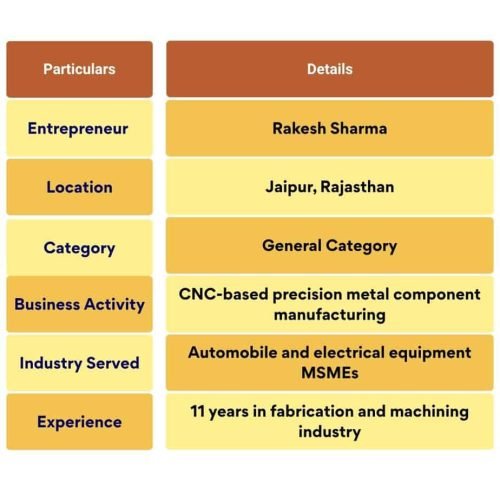
Rakesh Sharma, a General Category entrepreneur from Jaipur, Rajasthan, plans to establish a CNC-based precision metal component manufacturing unit. His business will manufacture high-precision components for automobile and electrical equipment MSMEs, supporting India’s growing manufacturing and engineering supply chain ecosystem.
Business Opportunity Identified
After spending more than ten years working in a fabrication and machining company, Rakesh developed hands-on experience in precision manufacturing and industrial component supply.
Over time, he noticed a growing shift within industrial clusters in Rajasthan and nearby regions. Medium-sized manufacturers were increasingly outsourcing precision-machined components to smaller vendors in order to reduce costs and improve operational flexibility.
During his industry experience, Rakesh observed several important market trends:
• Rising demand for precision fabrication and CNC machining
• Increasing outsourcing by industrial manufacturers
• Supply shortages among reliable local vendors
• Better margins in specialized component manufacturing
• Long-term growth potential in engineering-based MSME supply chains
Based on these observations, he decided to establish his own CNC-based manufacturing unit under the PMEGP scheme.
Project Cost Structure
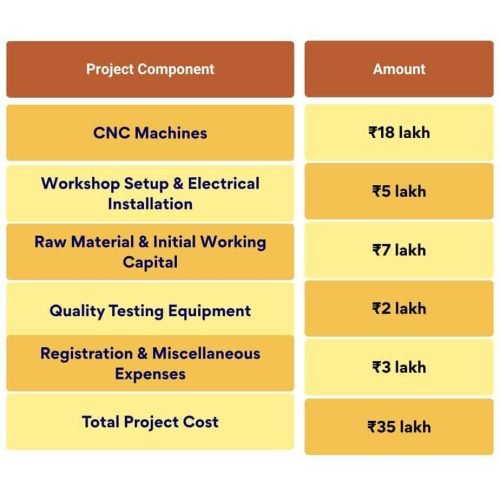
The proposed manufacturing setup required investment in machinery, workshop infrastructure, working capital, testing equipment, and initial business setup expenses.
The total project cost was estimated at ₹35 lakh.
How PMEGP Worked in this Case?
i) Entrepreneur Contribution:
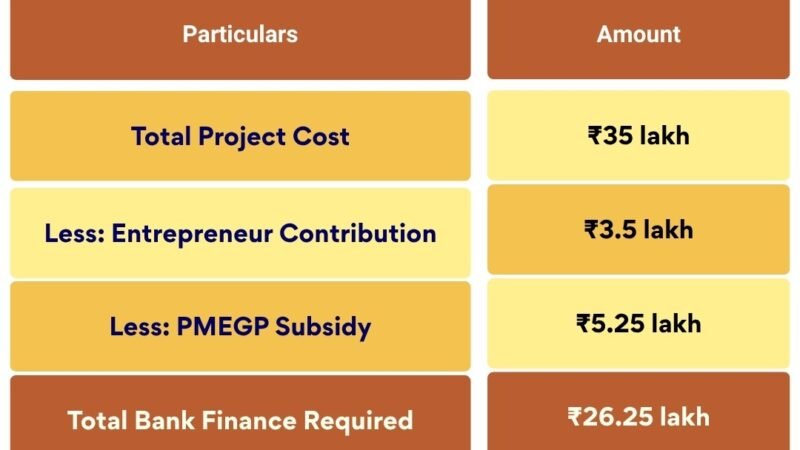
Under PMEGP guidelines, General Category applicants are required to contribute 10% of the total project cost from their own funds.
In this case, Rakesh arranged his contribution through personal savings accumulated during his years of employment.
Particulars | Amount |
Required Contribution (10%) | ₹3.5 lakh |
Contribution Made by Rakesh | ₹3.5 lakh |
ii) PMEGP Margin Money Subsidy:
One of the major advantages of PMEGP is the margin money subsidy support provided by the government. For urban manufacturing projects under the General Category, the applicable subsidy rate is 15% of the eligible project cost.
Accordingly, Rakesh became eligible for a subsidy of ₹5.25 lakh.
Particulars | Details |
Subsidy Rate | 15% |
Eligible Subsidy Amount | ₹5.25 lakh |
Important Note:
It is important to understand that the subsidy amount is not directly disbursed to the entrepreneur immediately. Under PMEGP guidelines, the subsidy is initially parked as a Term Deposit Receipt (TDR) with the financing bank and adjusted after the unit successfully completes the prescribed operational lock-in period.
iii). Bank Finance Requirement
Based on the project requirements and PMEGP financing structure, the bank sanctioned a combination of term loan and working capital finance. The approved assistance resulted in a total bank exposure of ₹26.25 lakh, as detailed below.
Loan Structure Approved by the Bank
Based on the project’s investment and working capital requirements, the bank approved a combination of term loan and cash credit facilities to support the establishment and operation of the manufacturing unit.The financing bank structured the loan as follows:
Loan Component | Amount |
Term Loan | ₹21 lakh |
Working Capital Cash Credit Limit | ₹5.25 lakh |
Total Bank Exposure | ₹26.25 lakh |
(If you are an Industry Expert, then Share about your expertise with us on MSMETALK Podcast)
Key Challenge Faced
Although the RBI’s revised MSME lending framework significantly improved access to collateral-free financing for eligible Micro and Small Enterprises, practical challenges still remained for entrepreneurs whose project funding requirements exceeded the ₹20 lakh threshold.
In Rakesh’s case, the total bank finance requirement reached ₹26.25 lakh due to the scale of machinery investment and working capital needed for the manufacturing unit. While the revised norms provided relief for the first ₹20 lakh portion, the additional exposure created uncertainty regarding the bank’s collateral expectations and overall loan structuring approach.
This created uncertainty because:
• He did not own commercial property
• Family-owned property was jointly held and difficult to mortgage
• Arranging third-party collateral could delay loan approval
• Machinery suppliers required advance payment timelines
(If you want to know how innovative startups championing preventive healthcare industry, and also want to learn about the opportunities preventive healthcare industry brings for new entrants, read MSME TALK’s Blog- Preventive healthcare: Potential future of Indian Healthcare Industry)
How the Bank Evaluated the Proposal
i) Parameters Evaluated :
- Technical expertise and industry experience of the entrepreneur, including knowledge of CNC machining, manufacturing processes, quality standards, and day-to-day operational management of a precision engineering business.
- Market demand projections and business potential, based on industry trends, growth in the automobile and electrical equipment sectors, and expected demand from MSME customers.
- Debt Service Coverage Ratio (DSCR) and overall repayment capacity, to assess whether the projected earnings would be sufficient to comfortably meet loan repayment obligations.
- Projected cash flows, revenue estimates, and profitability assumptions, ensuring that the business model was financially viable and sustainable over the long term.
- Eligibility under Udyam Registration and MSME guidelines, confirming compliance with applicable norms and scheme requirements.
- Verification of machinery quotations and project cost estimates, to ensure the proposed investment was realistic and adequately supported by supplier documentation.
- Machinery installation schedule, production capacity, and operational readiness plan, to evaluate how quickly the unit could commence commercial production.
- Buyer intent letters, existing customer relationships, and potential order pipeline, providing evidence of market acceptance and future revenue opportunities.
- Banking track record, credit behaviour, and CIBIL history, to assess the entrepreneur’s financial discipline, creditworthiness, and overall risk profile.
ii) Bank’s Observations:
- Strong technical competence of the entrepreneur, demonstrated through hands-on experience in CNC-based manufacturing and a clear understanding of production processes, quality control, and industry requirements.
- Established and credible customer base or strong buyer intent visibility, indicating that the business already has access to potential orders and reduced market-entry risk.
- Healthy projected profitability and sustainable financial structure, supported by realistic assumptions on pricing, costs, and expected order flow.
- Clear evidence of growing demand in the target industry segments, particularly from automobile and electrical equipment MSMEs, ensuring long-term business relevance.
- Well-structured and practical business implementation plan, including defined timelines for machinery installation, production commencement, and operational scaling.
- Alignment with MSME sector lending priorities and manufacturing growth focus, making the project strategically relevant for institutional credit support.
- Satisfactory credit profile and banking discipline, reflecting responsible financial behaviour and reducing repayment risk for the lending institution.
- Overall positive risk assessment with strong viability indicators, making the proposal suitable for financing under MSME lending frameworks.
How CGTMSE worked in this case?
As, the total bank finance requirement reached ₹26.25 lakh due to the scale of machinery investment and working capital, so, to reduce lending risk of lending, the bank used guarantee coverage under the (CGTMSE).
How the Structure Worked:
Portion Up To ₹20 Lakh
Particulars | Treatment |
First ₹20 lakh | Treated under collateral-free MSME lending norms |
Risk Coverage | Covered under CGTMSE guarantee support |
Remaining Portion: ₹6.25 Lakh
For the amount exceeding ₹20 lakh, the bank used internal discretionary approval based on:
• Strong projected cash flows
• Confirmed industrial demand
• Technical expertise of entrepreneur
• Existing market relationships
• Viable repayment capacity
Instead of demanding full property collateral:
• The bank accepted a limited personal guarantee
• No immovable property mortgage was taken
• Additional CGTMSE-supported structure was explored as per bank policy.
(Adopting Circular Economy ideas can help businesses to grow exponentially, want to know how? Listen to MSME TALK latest Episode #31 Circular Economy and MSMEs Ft. Siddharth Lulla, Principal- Intellecap)
Financing Outcome and Business Performance
After evaluating the project’s viability, repayment capacity, and applicable scheme benefits, the bank approved the financing proposal without requiring immovable property collateral. The final approval structure is summarized below.
Particulars | Status |
Total Bank Finance Approved | ₹26.25 lakh |
Property Collateral | Not required |
CGTMSE Coverage | Applied on eligible portion |
PMEGP Subsidy Eligibility | Approved |
Loan Type | Term Loan + Working Capital |
Within 18 months, the manufacturing unit started achieving stable operational and financial performance. With growing demand, repeat industrial orders, and timely execution of the project, the business gradually strengthened its position within the MSME supply chain ecosystem.
The enterprise not only generated regular revenues and employment but also improved the entrepreneur’s banking profile, creating opportunities for future expansion and additional MSME support benefits.
i) Operational Performance:
• Monthly turnover reached approximately ₹9–10 lakh
• Components supplied to 14 MSME industrial buyers
• GST registration and regular compliance achieved
• Repeat orders received from automobile component vendors
ii) Employment Generation:
Employment Type | Number |
Machine Operators | 8 |
Welders & Fabricators | 6 |
Supervisors & Technicians | 3 |
Helpers & Support Staff | 5 |
Total Employment Generated | 22 |
iii) Financial Impact:
The business achieved several positive outcomes that strengthened its financial position and future growth prospects:
- Timely loan repayments, helping build a strong credit history and demonstrating financial discipline.
- Improved banking credibility, making it easier to access future loans, working capital facilities, and other financial support.
- Stronger supplier relationships, resulting in greater trust, smoother procurement, and in some cases better payment terms.
- Improved cash-flow stability due to consistent business operations and growing customer orders.
- Eligibility for enhanced working capital limits, enabling the business to manage larger orders and support expansion plans.
iv) Growth Opportunities opened
The entrepreneur also became eligible to explore:
- Machinery modernization and technology upgradation support to improve productivity and manufacturing efficiency.
- MSME cluster development programs, providing access to shared infrastructure, industry networks, and common facilities.
- Export registration opportunities, creating a pathway to serve international markets and diversify revenue streams.
- Quality certification and government support schemes that can enhance competitiveness and support future business growth.
This example demonstrates how:
• PMEGP subsidy support
• RBI’s revised collateral-free MSME lending framework
• CGTMSE guarantee mechanism
can work together even when the total loan exceeds ₹20 lakh.
(Subscribe for alerts to stay updated with launch of new podcast episodes and blogs about MSMEs & Startups)
Conclusion
For genuine first-generation entrepreneurs with viable manufacturing or service projects, PMEGP continues to be one of India’s strongest credit-linked self-employment schemes.
The 2026 RBI amendment significantly improves access to formal finance by:
• increasing the collateral-free limit to ₹20 lakh
• strengthening credit flow to MSMEs
• improving bank confidence through CGTMSE-backed lending
• reducing dependence on property-backed borrowing for new entrepreneurs
A well-prepared DPR, credible repayment capacity, and strong market viability can substantially improve the chances of obtaining higher-value MSME loans with limited or no traditional collateral.
Sources
- RBI Lending to MSME Sector (Amendment) Directions, 2026
- PMEGP Guidelines issued by KVIC
- CGTMSE Operational Guidelines
- Ministry of MSME Notifications
Disclaimer: The above case study is a hypothetical illustration created for educational purposes to explain how PMEGP, CGTMSE and RBI’s revised MSME lending framework may work in practice. Actual loan approval depends on bank policies, project viability and borrower eligibility.