

Contents
ToggleTReDS Platforms in India: Structure, Participants, and Latest Developments
This blog provides an overview of the Trade Receivables Discounting System (TReDS) and how it helps MSMEs convert invoices into quick working capital. It explains the key participants in the ecosystem, reviews the major TReDS platforms operating in India, and highlights important policy developments, including key announcements from Union Budget 2026–27 that aim to strengthen MSME invoice financing.
What is TReDS?
TReDS (Trade Receivables Discounting System) is an electronic platform regulated by the RBI that enables MSMEs to convert their trade receivables (invoices) into immediate liquidity. Through this mechanism, MSME sellers can discount invoices raised on large corporate buyers with the help of banks and NBFCs financing those invoices based on the credit of the buyers, ensuring faster realization of payments and improved working capital management for MSME sellers.

Why TReDS Matters for MSME Cash Flow?
For MSMEs, TReDS offers several advantages like:
- Simple and fast access to working capital
- No recourse to MSME sellers
- No collateral requirement for accessing funds against invoices
- One platform connecting sellers, buyers, and financiers
- Fully digital and paperless transaction process
- Benefit in cost of borrowing by MSMEs
- Complete end-to-end online processing, including payments
- Competitive discounting rates determined through an auction-based system
- Smooth and secure data exchange between participants and the platform
- Transparent, standardized, and regulator-compliant operations
Who are the Participants in TReDS?

The TReDS ecosystem involves three key participants:
- MSME Sellers: Businesses registered under the Ministry of Micro, Small and Medium Enterprises through Udyam Registration can participate as sellers and upload invoices.
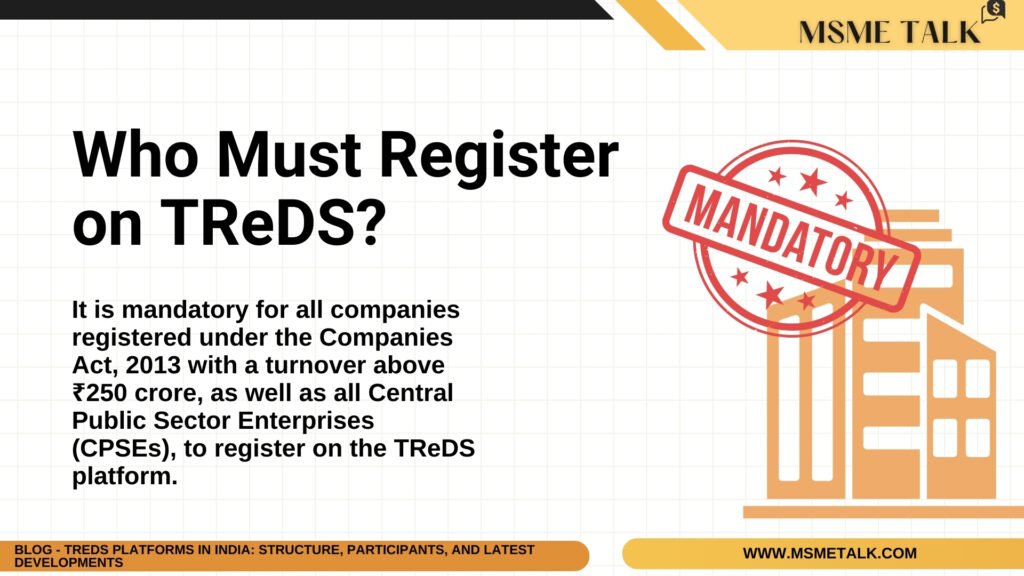
- Corporate / Government Buyers: Large companies, PSUs, and government entities that procure goods or services from MSMEs. It is mandatory for all companies registered under the Companies Act, 2013 with a turnover above ₹250 crore, as well as all Central Public Sector Enterprises (CPSEs), to register on the TReDS platform.
- Financiers: Banks and NBFCs that provide financing by discounting approved invoices.
Lorem ipsum dolor sit amet, consectetur adipiscing elit. Ut elit tellus, luctus nec ullamcorper mattis, pulvinar dapibus leo.
(Subscribe to the MSME TALK Newsletter for the latest industry news, insightful podcast episodes, expert perspectives, MSME-focused blogs, product and service updates, and emerging opportunities.)
TReDS Platforms in India
India currently has five RBI-regulated TReDS platforms that enable MSMEs to discount their trade receivables through a digital marketplace. These platforms connect MSME sellers, corporate buyers, and financiers such as banks and NBFCs, allowing invoices to be financed through competitive bidding.
As of 2025–2026, the RBI has approved five TReDS operators in India:
- Receivables Exchange of India Ltd (RXIL)
- M1xchange
- Invoicemart
- C2treds
- DTX (Domestic Trade Exchange) by KredX

The entry of DTX in 2025 made it the fifth licensed TReDS operator, expanding the ecosystem and increasing competition among platforms.
While all of them operate under the regulatory framework of the Reserve Bank of India, each platform differs in terms of its legacy, scale of operation, stakeholders support, technology infrastructure, network of buyers and financiers, onboarding processes.
Together, they aim to improve liquidity for MSMEs by enabling faster access to working capital against approved invoices.Across these platforms, thousands of MSMEs, corporates, banks, and NBFCs participate, helping unlock liquidity for suppliers and improving payment discipline across supply chains.
1. Receivables Exchange of India Ltd (RXIL)
Receivables Exchange of India Ltd (RXIL) was the first TReDS platform to become operational in India, launching in 2017.
It is promoted by:
- Small Industries Development Bank of India (SIDBI)
- National Stock Exchange of India (NSE)
This institutional backing gives RXIL strong credibility and makes it one of the most widely used TReDS platforms in the country with almost 35 % market share of the invoices discounted on TReDS.
Key Features:
- Strong participation from public sector banks and PSUs
- Well-established corporate buyer network
- Transparent e-auction bidding mechanism
- Robust compliance and regulatory framework
- Efficient digital onboarding and transaction processes
- Technology & Digital Integration
- Experience & Early Mover Advantage
Platform Highlights (Indicative):
- One of the largest TReDS marketplaces
- Participation from multiple banks and NBFC financiers
- Significant share of government and PSU buyers
RXIL is often preferred by MSMEs that supply to government departments or large public sector enterprises.
2. M1xchange
M1xchange is operated by Mynd Solutions Pvt Ltd and is known for its technology-driven platform architecture.It has become one of the most active TReDS platforms in terms of transaction volume and user adoption.
Key Features:
- API-based integration with corporate ERP systems
- Digital onboarding and automated workflows
- Real-time bidding by banks and NBFCs
- AI-based risk assessment and analytics
- Large network of corporate buyers
Platform Highlights:
- Thousands of MSME suppliers onboarded
- Participation from dozens of banks and NBFCs
- Strong presence among private sector corporates
3. Invoicemart
Invoicemart is operated by A.TReDS Ltd, a joint venture between:
- Axis Bank
- Mjunction services limited
The platform combines banking expertise with digital supply-chain finance technology.
Key Features:
- Full digital invoice discounting workflow
- Competitive bidding among financiers
- Real-time dashboard for sellers and buyers
- Transparent transaction tracking
Platform Strengths:
- Strong presence in industrial and manufacturing sectors
- Good participation from private sector corporates
- Integration with banking infrastructure
4. C2treds
C2treds is operated by C2FO Factoring Solutions Pvt Ltd, part of the global fintech company C2FO.
This platform brings international supply-chain finance expertise to the Indian TReDS ecosystem.
Key Features:
- Dynamic discounting options
- Early payment requests initiated by suppliers
- Global technology platform
- Fully digital onboarding and processing
Platform Strengths:
- Technology-driven approach
- Efficient for recurring transactions
- Flexible payment structures
C2treds focuses heavily on improving working capital efficiency and faster invoice settlement for suppliers.
5. DTX (Domestic Trade Exchange) – KredX
DTX (Domestic Trade Exchange) is the latest addition to India’s TReDS ecosystem, operated by the fintech company KredX.
The platform received final RBI approval in 2025, becoming the fifth licensed TReDS operator in India.
KredX had already built a large supply-chain finance network before entering the regulated TReDS space.
Key Features:
- Seamless digital user interface
- Data-driven credit analytics
- Strong NBFC and lender participation
- Fast transaction processing
Platform Strengths:
- Existing network of thousands of MSME suppliers
- Technology-focused platform design
- Quick deal execution
DTX aims to combine fintech efficiency with RBI-regulated TReDS infrastructure.
Comparative Overview of TReDS Platforms
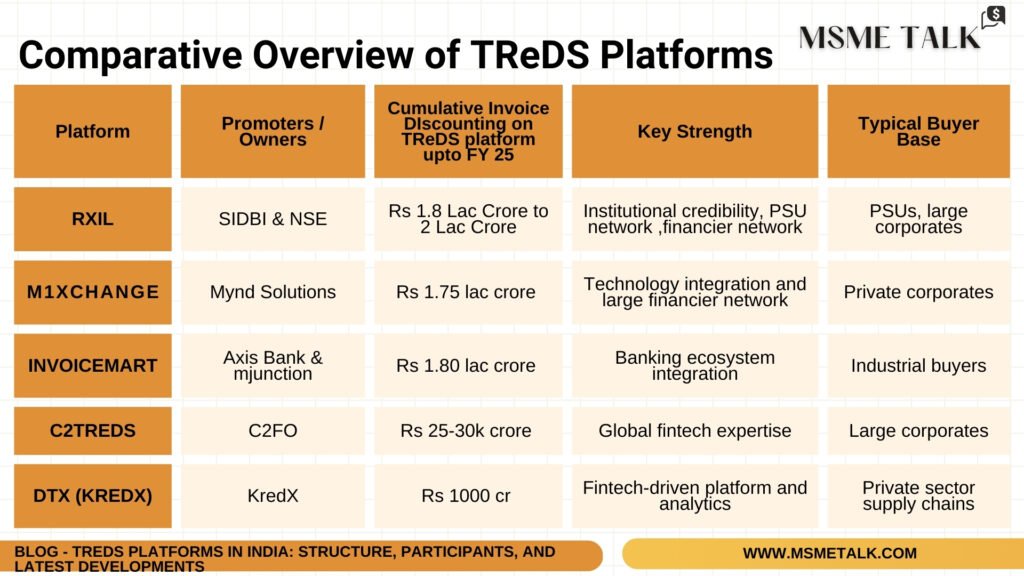
Cumulatively till date all the platforms together have discounted more than 7 lac crore invoices.
How to Choose the Right TReDS Platform?
To expand the ecosystem, the Government of India reduced the mandatory TReDS onboarding threshold for buyers.
Now, all companies with turnover above ₹250 crore and all Central Public Sector Enterprises (CPSEs) are required to register on a TReDS platform to support MSME suppliers.
This move is expected to significantly increase the number of buyers and transactions on TReDS platforms in the coming years.
(If you found this blog useful, don’t miss MSME TALK Podcast – Episode 57- How CFOs Can Use TReDS Optimally , that explores how CFOs from different types of organisations actually use TReDS, the challenges they face, and how businesses can maximise the platform’s benefits.)
Union Budget 2026–27: Major Developments for TReDS: (With Brief Explanation)
- Mandatory TReDS for CPSEs
All Central Public Sector Enterprises (CPSEs) will be required to route their MSME procurement transactions through TReDS.
This ensures formal recording of invoices, time-bound acceptance, and structured settlement – reducing delayed-payment risk in government-linked purchases. - CGTMSE Credit Guarantee for TReDS Transactions
Invoice discounting on TReDS will receive credit guarantee backing under CGTMSE.
This reduces risk for banks and NBFCs, encourages wider lender participation, and can improve competitive bidding and cost of funds for MSMEs. - GeM–TReDS Integration
The Government e-Marketplace (GeM) will be linked with TReDS to provide financiers real-time visibility into government procurement transactions.
This improves underwriting efficiency, speeds up invoice discounting, and strengthens the digital procurement-to-financing pipeline. - TReDS Receivables as Asset-Backed Securities (ABS)
TReDS-backed receivables will be introduced as a tradable asset class.
This enables development of a secondary market, expands liquidity beyond traditional lenders, and integrates MSME receivable financing with capital markets.Lorem ipsum dolor sit amet, consectetur adipiscing elit. Ut elit tellus, luctus nec ullamcorper mattis, pulvinar dapibus leo.
If you have any query related to working of TReDS platform, send us to connect@msmetalk.com or whatsApp https://wa.me/918097665085 , and we will try to get answer from our expert ecosystem.